Who this guide is for
This guide is for travelers who are looking at ryokan or hotel websites and thinking, “I still cannot tell if this place will work for me.”
It is especially helpful if you:
- have tattoos and want to avoid an awkward surprise at check-in
- are comparing several ryokan pages that use slightly different wording
- want to know whether a property has a truly safer private option
- need a faster way to decide whether to book, ask a question, or move on
Short answer
You usually do not need perfect Japanese to spot the main tattoo-policy signals on a ryokan or hotel website.
What you do need is the right reading order.
Start with:
- the communal bath rule
- any mention of private baths or in-room baths
- the booking conditions around those private options
If the page is still vague after that, do not guess. Ask the property directly before you pay.
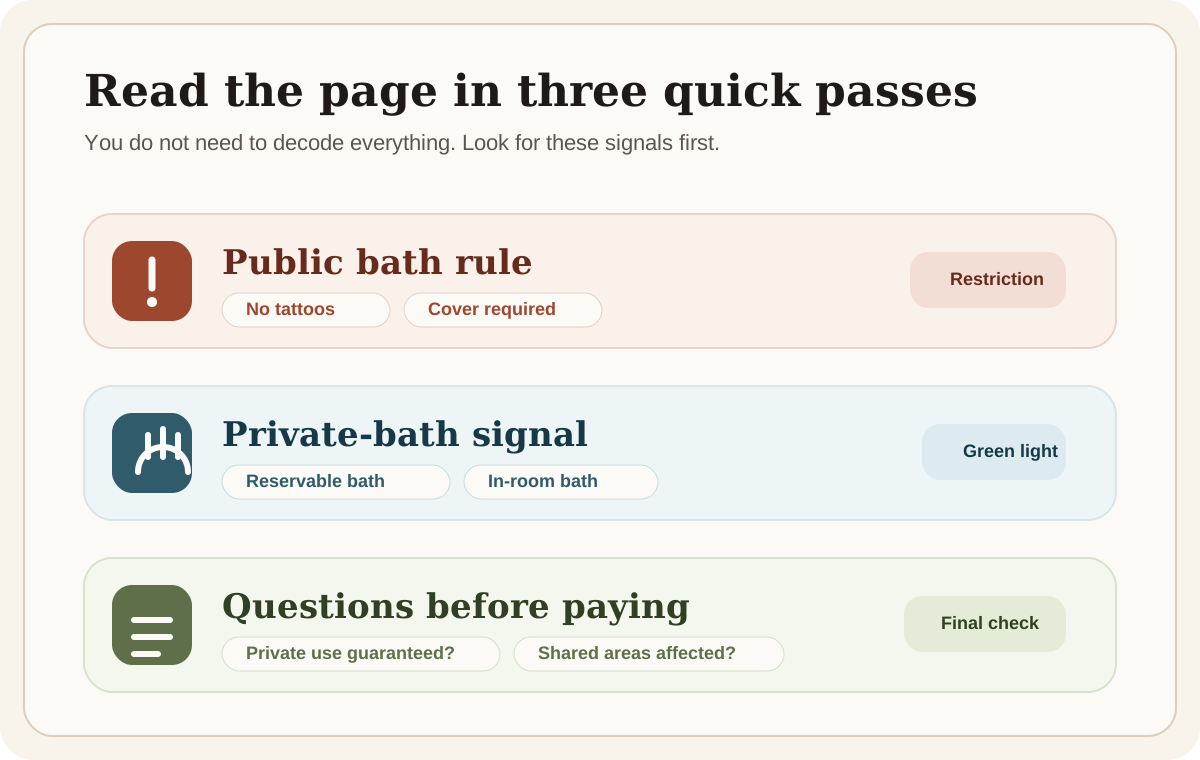
Read policy pages in three passes: communal-bath rule, private-bath signal, then the questions worth sending before you pay.
Where to look first on the page
Do not begin with room photos, awards, or the general stay description. Go straight to the bath information.
The most useful places are usually:
- the onsen or spa page
- the FAQ page
- room details for in-room baths
- facility rules or admission notes
- the private-bath reservation page, if one exists
This matters because tattoo rules are often written away from the main room description. If you only read the room page, you can miss the rule that actually affects the communal bath.
Wording that usually means the communal bath is off-limits
Some official pages are direct. That is helpful, even if the answer is not what you wanted.
Look for wording that clearly says:
- guests with tattoos may not enter
- tattoos, tattoo stickers, or body paint are not allowed
- tattooed guests may not use the large public bath
- communal bath use is limited unless tattoos are covered
For example, the official Skyspa S-PARK page at Hotel Keihan Universal Tower says there is no entry for guests with tattoos, tattoo stickers, or body paint. Ubuya’s official Q&A also says that, in principle, guests with tattoos are barred from using the spacious bath.
That kind of wording is a strong signal. It does not always mean the whole property is unusable, but it usually means you should stop assuming the public bath is an option.
Wording that can still leave room for a workable stay
Not every restrictive sentence means “do not book.”
Sometimes the property is really saying:
- the communal bath is restricted
- a cover rule may apply to smaller tattoos
- a separate private option may still work
This is where careful reading helps. A page can be strict about the public bath and still be a usable choice if it also offers a reservable private bath or a room with its own bath.
Wording that often signals a safer private option
This is the wording you want to slow down and read carefully.
Look for signals such as:
- private open-air bath
- reservable private bath
- family bath
- kashikiri bath
- attached open-air bath
- room with private bath
Hakone Yuryo’s official English site and FAQ are a useful example. They clearly explain that private open-air baths are available, how long they can be used, and how reservations work. That is much easier to act on than a vague line that only says “private bath available.”
If you see clear private-bath wording plus reservation details, that is usually a much stronger sign than a general lifestyle description or a booking-site label.
What to ask before you pay
If the page is not clear enough, send a short question before you book. You are not asking for a long explanation. You are trying to remove one or two specific risks.
Ask these questions:
- Does the tattoo rule apply only to the communal bath, or also to changing rooms and other shared areas?
- Is the private bath guaranteed for my stay, or does it need a separate reservation?
- Is there an extra fee for the private bath?
- Is the bath in the room, or in a separate part of the property?
- If the room has a bath, is it hot spring water or a standard bath?
If the property cannot answer those basic questions clearly, that is usually a sign to keep looking.
Red flags that should slow you down
Some pages are not openly negative, but they still create too much uncertainty.
Watch for these red flags:
- the page says “private bath available” but gives no booking method
- the communal-bath rule is missing entirely
- the only useful information appears on a third-party booking site, not the official site
- the room has beautiful bath photos, but the page never says whether it is hot spring water
- the property sounds tattoo-friendly at town level, but the property page says nothing specific
None of these points prove the stay will fail. They simply mean the page is not yet giving you a safe booking signal.
What counts as a strong green light
A property page becomes much easier to trust when you can confirm all three of these points:
- the communal-bath rule is stated clearly
- the private option is described clearly
- the reservation method or usage condition is stated clearly
That combination is what lets you move from “maybe” to “I can actually book this.”
When to verify with the official source
Always verify these points with the official website or by phone before booking:
- whether tattoos affect the communal bath
- whether private use is guaranteed or separately reserved
- whether extra fees apply
- whether the room bath is actually an onsen bath
- whether any rule has changed since the page was last updated
Policies can move, and a travel guide should not be treated as the final authority. Check the official website or ask the property directly before you book.
Next guide to read
- Read Private Onsen in Japan for Tattooed Travelers: The Lowest-Risk First Option if you want to compare the safest private-bath setups next.
- Read Booking a Tattoo-Friendly Ryokan: 9 Checks Before You Pay if you are close to paying and want a final booking checklist.
- Read Can You Go to an Onsen in Japan With Tattoos? if you still want the broad rule before choosing a property.